When we think of Noah and his great ship, we often envision only a boatload of animals and maybe some bins of fodder. What else might Noah have taken into the Ark with him? Well, how about tools?
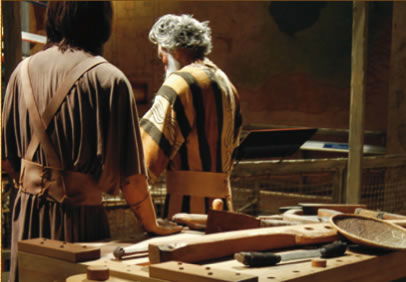
This exhibit inside AiG’s Creation Museum displays some of the kinds of tools Noah may have used over 4,000 years ago.
Can you imagine starting life in a new world where there was only you and your three sons (and wives)? We can’t—not without first collecting a vast array of useful items that would not be available on the other side of the Flood.
Noah probably had a real blast visiting all the Lowe’s and Home Depots of his day, buying tools. Some of those tools may even have formed the pattern for those we use today.
What sort of tools might Noah have needed? Well, he would have likely needed plows with iron blades, because those who forged iron prior to the Flood would no longer be living after the Flood. It might have been years before his sons and grandsons-to-come would have the capacity to mine ore and turn it into iron again.
What about saws? Good steel saws and sharp axes would be invaluable for building new homes and barns.
Cutting tools, blacksmith skills, masonry skills, and a hundred other things would be required to forge a new life on the new earth God was giving them. Although pre-Flood man was very intelligent, he couldn’t be expected to possess every skill, and Noah knew this. So, what else might he take into this New World?
What would you have taken?
Help us build a full-scale Noah’s Ark! Visit ArkEncounter.com to see how you can help us raise $24.5 million in donations for an all-wood Ark in northern Kentucky.
In reading the article about the Ark on this site I notice the use of the words "boat" and "ship". The Hebrew word for 'ark' is different than the word for 'boat' or 'ship'. An ark, in its strictest sense, is a box or chest. The biblical Ark was not a boat or ship- it did not have a curved bow, and was not designed to cut through the water under propulsion, since it had none. Nor did it have a rudder, since there was no purpose in steering. The Ark only had to float on the surface of the water.
Additionally, a curved hull design would decrease the available interior space for cargo- impinging on the principal function of the ark as a cargo carrying vessel.
A reconstructed biblical Ark would not have the popular aesthetics of the Ark as imagined in popular literature and art. People expect to see a structure that is 'boat or ship-like', because in general they have been casually or even carelessly educated in essential scriptural matters.
For the most part, religion has done a very poor job of educating people about the Deluge, and of intelligently defending the biblical account of creation. There is an abundance of emerging scientific fact that reinforces the Genesis account. True and responsible Christians should avail themselves of that information.
Yes, the Hebrew word for what we translate as ark is different than the one for boat or ship. However, keep in mind that outside the Flood chapters of Genesis, this word is only used twice, and both time are describing the object in which Jochebed put her son Moses, when she set it in the Nile. I find it difficult to believe that a box or a chest would have floated. In translations other than the KJV, that word is translated as basket when referring to the ark that kept Moses safe in the river.
I like AIG's thinking behind a curved bow at the front and a "wind rudder" at the back, to steer the ark into the waves with reduced motion for the passengers, and to avoid being broad-sided from a giant wave. And I wonder if there is more structural integrity from a curved hull than there is from a flat bottom and sides meeting in a box-like configuration.
And even though it may have looked like a ship of today, it lacked propulsion and it's main purpose was to serve as a "storage chest" of sorts for some very valuable passengers.
So I think it was more "ark' than "ship"
"An ark, in its strictest sense, is a box or chest". No it isn't. __Ark is "TBH" in Hebrew. Used for Noah's Ark and Moses' baby basket. .__Prof Chaim Cohen (philologist and professor of Hebrew language) wrote… "The "box" idea seems to have originated from the Egyptian "loan-word" theory by H. Brugsch …(Leipzig, 1867-1882)"__…and Brugsch's proof? Well the words look similar. __Well, my name is "Tim", which is the Indonesian word for "Team". Same word. No connection.__So a foremost expert on the origin of Hebrew words says the your Brown-Driver-Briggs Hebrew Lexicon has a mistake in it. That's OK, it is NOT God's word. Question it. So if TBH has NOTHING to do with rectangular boxes, or tell us anything about shape, where does that leave us? The Biblical text allows us to choose an ark anywhere from a rectangular box to a streamlined double-ended ferry – and anything in between – so long as it is 300x50x30 cubits. So AiG picked a logical design to do the job.
Bison, AiG has published articles online & even dedicated an entire issue of Answers magazine to the flood, ark, & especially their unique ark design. Its curved features & rudder would help stabilize it, not necessarily propel or steer it. I would simply invite you to keep an open mind to what design Noah might have used since God commanded him to build it, not us, & obviously it served the purpose.
God bless your work!
I'm wondering, was Noah a billionaire of his time?
I note it's costing $24 Mil to build a modern-day ark, and there certainly must be a team of construction/trades workers for the task (obviously they don't work for free, and certainly didn't in Noah's day, even if there even WERE non-slave-laborer craftsmen for hire in 2,300 BC!).
And surely the "Home Depots" of his time (as if they existed, LOL!) presumably didn't just give away their tools, tons of lumber and other construction materials (pitch tar, etc).
And what did Noah and his Sons do for physical sustenance for themselves and their families while they devoted their lives to building the Ark?
Hence my question: had Noah amassed the fortune of a King to pull off a construction project that rivaled that of Egyptian pharoah's building of the pyramids (or at least the Titanic ship-building project of more recent times)?
Naturally we don't fully know how the ark was built (with labor I mean). It seems reasonable that Noah would have had help. With a significantly lower population, property could easily be staked off in big chunks. Wouldn't necessarily mean he was wealthy as we would think of it. Perhaps he just had a lot of land. He could have traded land for labor.
It is also possible that his land would have had a lot of the resources he needed for building the ark. Mining that material could have happened before or after the "sale." Land would have been much richer in the distribution of its resources prior to the flood.
The same would be true of the food that was gathered for their sustenance. The food of the day would have been "greens," nuts and seeds. That's not difficult to store or gather. There is also trade to consider for anything else they might have needed.
All in all, Noah could have easily been an ordinary man of his day just using what was around him.
And that doesn't even take into account the fact that it's no stretch to say the ark took over a hundred years to build, and by a race of super-humans, essentially. It was still a great task, but by no means impossible, especially since it was God's project all along.
If I live to 600, I'll be pretty well off too!
Why wouldn't the financial mechanics of property inflation, population pressures and investment growth not be applicable to Noah? These guys lives long enough to buy some land, plant a forest and harvest OLD GROWTH lumber.
And then some… Why wouldn't Noah's righteous ancestors have left an inheritance? Methuselah's piece of paradise might have fetched a king's ransom after a 1000 years as a family estate.
It is quite unreasonable to expect Noah did NOT have great wealth.
And this speaks all the more favouably of Noah's faith in giving it all up on a word from God.
Besides that, Genesis 6:14 was written in Hebrew or at least proto hebrew. It is possible that the Hebrew word used for Ark, Tebah meaning box:–ark, was the best word thew could use. It was 2348 B.C. and the first ship ever seen. (Genesis 6-9, Big Book of History, James Ussher, Annals of the World) Even today, there are 6,909 living languages with english as the international language of use. (http://www.translationblog.co.uk/exactly-how-many-languages-are-there-in-the-world/) Not everything translates between them smoothly. There could be room for interpretation while never compromising the integrity of the literal meaning
God Bless this wonderful work being done to further the message of God's Holy word.
Personally, if I'd have been at Home Depot with a shopping list for the Ark, I would have picked up a fly swatter and at some point would have eliminated those two Mosquitos.
Mosquitoes are an interesting subject. Males only live for several days, but females live for several weeks. From the little bit of research I just did, it seems that modern mosquitoes would not have survived the year-long Flood on the ark; but then again, maybe like humans back then, they had longer lifespans too. Since it didn't rain the entire year, it's possible that mosquitoes never officially boarded the ark to be swatted. Their eggs resemble rafts, so after the 40 days of rain, they might've continued their normal lifecycle (whatever "normal" was for a mosquito back then) upon floating vegetation.